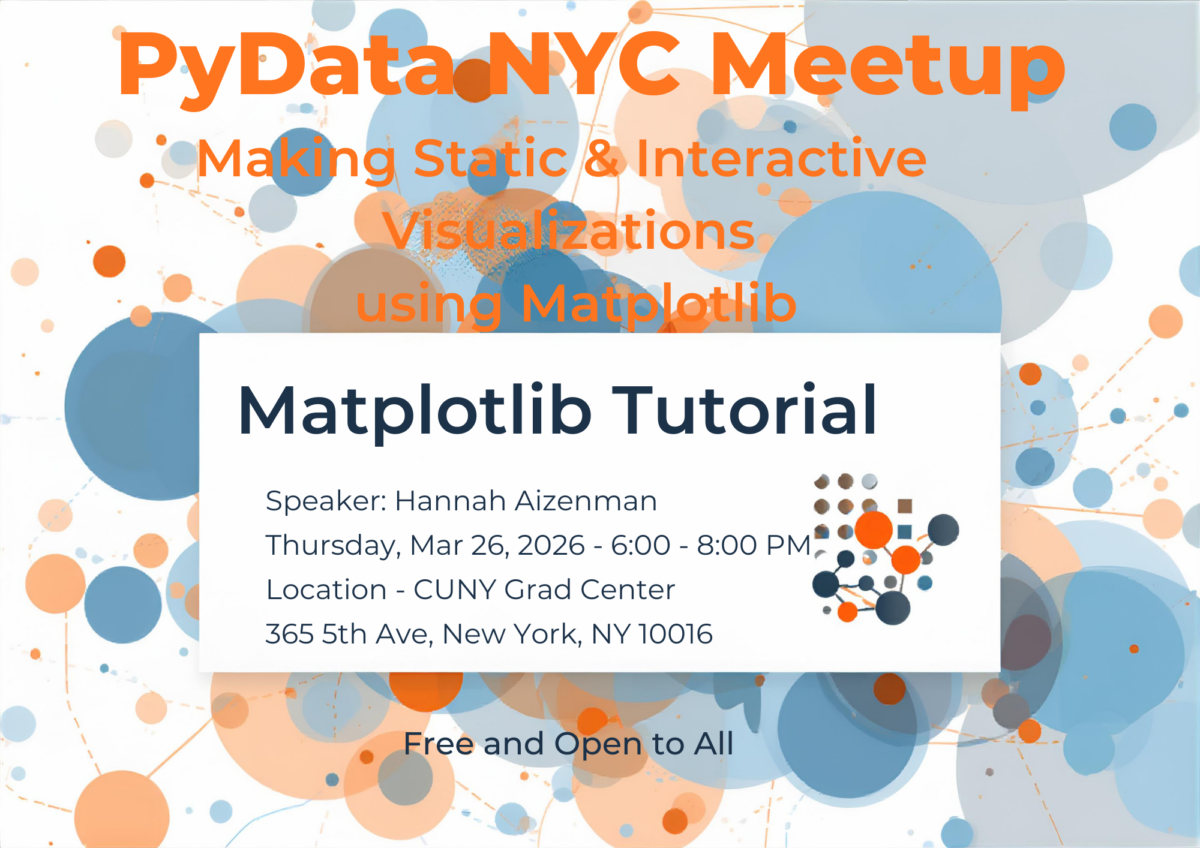
In this workshop with PyData NYC, we will explore 311 dataset, starting with exploratory charts (including maps), maybe creating a linked animation, and concluding with a simple interactive visualization. In doing so, we will unpack some of the fundamental concepts that underlie the architecture of Matplotlib, hopefully providing attendees with the foundation for creating effective visualizations using Matplotlib. And the vocabulary to make more effective use of AI tools. Matplotlib is a big library, and it can be difficult to know where to start.

This demo-tutorial is a guided tour through many of the essential features and concepts of Matplotlib so you can get started making publication-quality, animated, and interactive figures. We will be using the 311 dataset as a case study.

This event will be held at the CUNY Graduate Center (365 5th Avenue) in Manhattan. Register here.

Christian Casazza is a data engineer who has built a open-source data platform on top of NYC Open Data. In this talk, he discusses using open source data engineering tools like Dagster, Polars, and DuckDB to ingest and clean gov data like NYC 311 and from the NYC Checkbook API. He will show participants how they can build on top of the clean, curated government data to build applications for the public good.

Anyone who is interested in using government data to improve the city’s operations and citizens quality of life should attend.

The first part of the event will involve understanding the core open source technologies anyone working with data should know. Understanding the logic behind open source tools is important to appreciate how much faster, cheaper, and simpler modern data app building is with open source tools. These tools can be applied for anyone’s civic interests and day to day work. The second part of the event will discuss some of the tools I’ve built around open source data. We will discuss using QueryStation.app and NYCStats.app and how New Yorkers can go there to learn about their city.

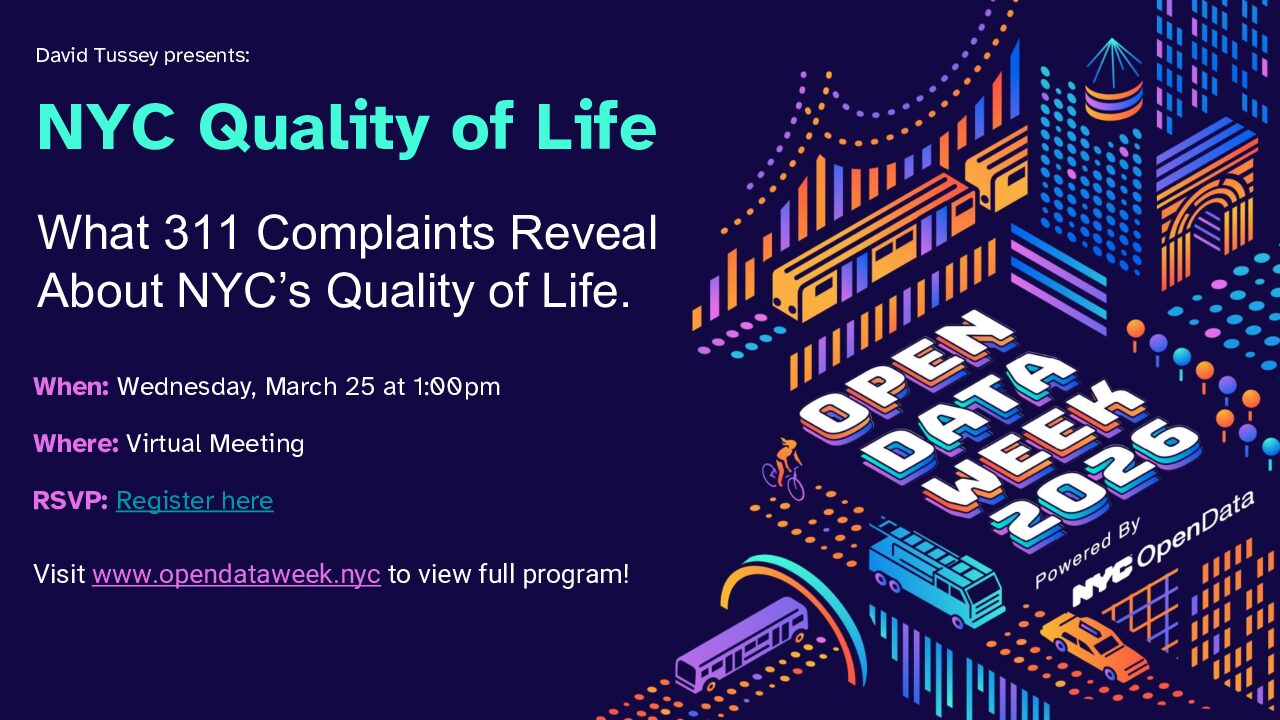
In this session, David Tussey — retired technology executive and former executive director in the NYC Department of Information Technology and Telecommunications (DoITT, now OTI) — presents a data-driven Quality of Life Index built entirely from NYC’s 311 Service Request open dataset. Drawing on more than 13 million complaint records spanning 2020 through 2025, the analysis tracks 30 complaint categories across five quality-of-life domains — from shelter conditions and neighborhood cleanliness to street safety and social distress — and measures how each has changed relative to a pre-established baseline. The methodology, developed with guidance from mentor Dr. Jun Yan of the University of Connecticut Department of Statistics, applies seasonally adjusted indexing and Statistical Process Control techniques to surface meaningful trends in public service demand.

Participants will see a live walkthrough of the analytical pipeline built in R using NYC Open Data, including data preparation, index computation, and publication-ready visualizations. The session is part demonstration, part methodology discussion, and part provocation — the findings raise real questions about urban quality of life that city agencies, policymakers, and engaged New Yorkers will want to wrestle with.

This session is ideal for city employees working in technology or data roles, academics and students interested in applied urban analytics, and anyone curious about what 311 data can reveal when you look beyond individual complaints. No prior technical background is required to follow the findings, though data practitioners will find the methodology discussion valuable. Attendees are encouraged to come with questions.

This session showcases the Brooklyn College Open Data Student Gallery, a publicly available resource featuring original civic research projects conducted by graduate students at Brooklyn College. Developed as part of a reproducible research curriculum, students used real NYC Open Data datasets to investigate questions that mattered to them — from public safety and housing trends to environmental and social issues affecting New Yorkers. Using R, Quarto, and the open-source nycOpenData package, each student produced a fully reproducible research chapter that is now published as part of an open educational resource. The gallery can be explored here:
https://martinezc1-nyc-open-data-student-gallery.share.connect.posit.cloud/.

The session will begin with a brief overview of how NYC Open Data was integrated into the classroom and how students moved from research question to public-facing publication. The majority of the session will feature short lightning talks from participating students, each presenting their project, dataset, analysis approach, and key findings. Attendees will gain insight into how real civic datasets can be used in higher education to build technical skills, critical thinking, and meaningful public scholarship.

This session is ideal for educators, civic technologists, students, and anyone interested in public data, reproducible research, or innovative teaching approaches. Participants will leave with concrete ideas for incorporating NYC Open Data into their own classrooms or projects — and examples of how student work can move beyond traditional assignments to become lasting, shareable contributions to the civic data ecosystem.

As part of NYC Open Data Week 2026, the CUNY Public Interest Technology (PIT) Lab will host a week-long Open Data Takeover of the NYC PIT Pop-Up at the Oculus / World Trade Center. The activation advances Open Data Week’s goals of accessibility, civic learning, and practical use of open data by bringing open data projects into a highly visible, public-facing space. Attendees can drop in at any time during the hours below for a demonstration of the tool and to speak with the presenter. Most of the demos will also be streamed live from the Pop-Up on its Twitch (https://www.twitch.tv/cunypitlab). Inside the Oculus, the Pop-Up is located on the Main Floor C2, in the South Concourse, at Shop #53 (next to M.A.C. Cosmetics). View the full PIT Lab schedule. No RSVP needed, just stop by!

[2pm–6pm]
Mike Spade – DuBois Does Data
35 years after slavery, Du Bois set out to provide a definitive image of the Negro condition in the United States. His data efforts not only quantified economic parity or lack thereof, he also focused on where people lived, and how they lived. During the 1900 Paris Exposition, he shared his findings with the world. But how do those findings hold up 125 years later? What has changed? Has anything stayed the same? At Du Bois Does Data, engage with his visuals, portraits, and data in a multi-sensory experience. Scents derived from the life and experience of W.E.B. Playlists charting the course of Black American music from his birth to his death, a day before the “I Have A Dream Speech.” Books celebrating his work and a first edition copy of his completed passion project, Africana. Curated vintage stamps in his image, portraits, and his article in Africana will serve as activations for A/R experiences, bringing the nostalgia into the palm of your hand. In Du Bois Does Data, we also used Python to evaluate the condition of Black Americans 125 years after his exhibit using Census data in 6 Jupyter Notebooks.

Ray Brescia – Gamifying Know-Your-Rights Information
This presentation will explore the power of gamification and then describe one current work in progress, an online game, “Haunted Housing,” that is designed in partnership with community-based advocacy organizations in New York City to educate youth, particularly from immigrant communities, about housing rights.  Gamification can be utilized in many other contexts–from immigrants’ rights to school discipline–and I will describe our ground-up method for developing this tool and encourage others to explore similar initiatives in other contexts.

Merlin Valdez – VoteFeed.org
VoteFeed.org is a Twitter/Bluesky-like user experience that allows constituents to interact with their respective U.S. representative in congress by sharing their opinion on policies up for vote in the legislative agenda.

Unlock the secrets of the city in this interactive data treasure hunt! We will present a series of data-driven prompts guiding attendees through unique statistical signatures found in NYC Open Data covering topics like taxis, crime, schools, and parks. Participants will spend the session solving progressively difficult analytical questions, requiring everything from simple lookups to complex cross-referencing across datasets.

As we discuss the answer to each prompt, a panel of experts from the New York City Chapter of The American Statistical Association will take the investigation one step deeper, presenting a bite-sized lesson on a statistical concept related to the question. Attendees will learn about tools that can be adapted to many other settings, such as distributional thinking, outlier detection, hypothesis testing, and exploratory data analysis. The session culminates in a final puzzle: figuring out the hidden theme that connects all the mystery answers together. This session is ideal for data scientists, students, civic tech enthusiasts, or anyone looking to sharpen their analytical toolkit, open data scientific educational opportunity for all, undergraduate and graduate students very welcome.

UnSchool of Data is BetaNYC’s open space unconference for networking, co-creating, and learning. It brings together city residents, technologists, civic leaders, students, advocates, policy nerds, government staff, elected officials, journalists, designers, and more to leverage open data to tackle some of the most pressing issues in NYC and beyond.

It’s a community driven day for turning open data into civic solutions.

UnSchool of Data has these underlying goals:

  1. Convene community members to share civic insights and ideas.
  2. Create processes/projects that people will use for further action.
  3. Foster formal and informal communities of practice and action.

Learn more about UnSchool of Data and how it works at www.schoolofdata.nyc/unschool.

As one of the largest open data providers in the world—with data accessed more than 2.6 million times and downloaded from a total of more than 900,000 times—NYC Open Data has critical information about how New Yorkers live. But a question remains: For what end? What questions do we want these systems to answer? What problems do we want to solve?

On Friday, March 27th from 2:00 PM to 3:30 PM at Brooklyn Central Library, The GovLab, the Brooklyn Public Library and Alliance for Public Interest Technology at New York University will be hosting a special “Questions Lab” as part of New York City Open Data Week 2026. In it, we will give New Yorkers the opportunity to formulate good, data-driven questions about the issues they care about and to meaningfully connect those questions to specific datasets in NYC Open Data or other, non-traditional repositories. It will include a brief presentation followed by small group discussion on the questions that New Yorkers care about:
2:00 – 2:20 PM: Setting the Scene: Stefaan Verhulst (Co-Founder, The GovLab), Diana Plunkett (Director of Data Analytics, Brooklyn Public Library), and Manny Patole (Senior Fellow, Alliance for Public Interest Technology) will explain the work that Brooklyn Library and The GovLab are doing to help residents not only understand data that describes them but to engage with it meaningfully to solve problems they care about.
2:20 – 2:50: Topic Mapping and Question Definition: Attendees will be broken into small groups and taught how to define data-driven questions. Each group will focus on a different domain prioritized by the New York Mayor’s Office.
2:50 – 3:30: Group Voting on Questions and Debrief: Each group will present their questions. Referencing NYC Open Data and other datasets, the collective group will identify what data might exist in New York to answer these questions. They will then vote on which questions they consider the highest priority based on demand, actionability, and the larger regulatory context.

The end result of this work will be a prioritized mapping of the questions that matter for New Yorkers. This event is open to any New York resident interested in data and how it can be used to set a policy agenda. Participants will leave the event with a practical methodology for developing well-crafted, data-driven questions and the work they produce will inform new open data research. Register here.

Join Paul Reeping, Director of Research at Vital City, for an interactive session exploring Vital City’s new Crime Data Explorer, a multi-decade, precinct-level platform covering complaints, arrests, and shootings in New York City. Paul will demonstrate how the tool works, explain the analytic framework behind it, and highlight key findings from Vital City’s most recent end-of-year crime report. Participants will gain a clearer understanding of long-term crime trends, how different categories are measured, and how to responsibly interpret citywide and neighborhood-level data.

The session will also look ahead. After walking through the Explorer, Paul will preview upcoming data initiatives at Vital City and invite participants to help shape future tools for data visualization, public safety measurement, and open data accessibility. This event is ideal for researchers, journalists, policymakers, technologists, students, and anyone interested in understanding crime trends and building better public data tools. Expect a mix of live demonstration, substantive analysis, and collaborative discussion about what New York City should measure, visualize, and build next.

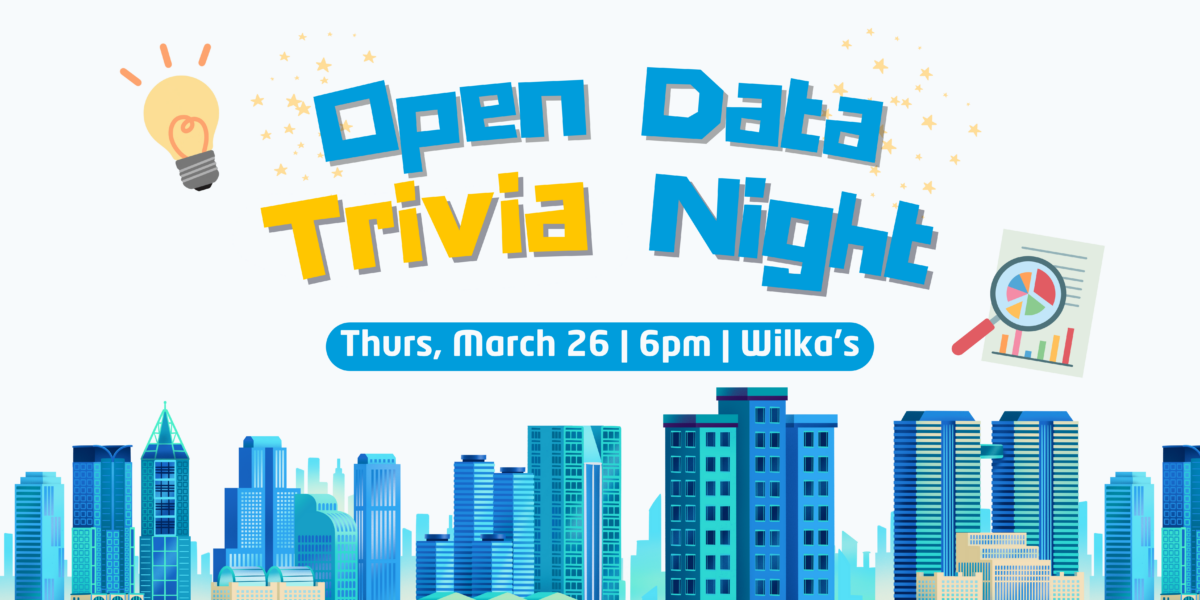
Think you can pivot table, left_join, and merge better than the rest? Join us at Wilka’s (241 Bowery, Lower East Side) for a trivia night with a data twist as we dive into NYC Open Data and you can flex your skills in a friendly competitive environment.

What to expect: Working in teams, you’ll tackle questions that require real-time data analysis using Excel, R, Python, or whatever language you prefer. You’ll get to play with data and connect with fellow data enthusiasts!

Who should attend: Data analysts, civic tech folks, and anyone curious about what you can uncover with NYC Open Data. All skill levels are welcome!