A collaborative hackathon to build public mapping resources using NYC Open Data

How Maps Speak is a collaborative hackathon run by Parisa Setayesh and Shokran Rahiminezhad, two PhD candidates at the CUNY Graduate Center, focused on building a public teaching resource for mapping using NYC Open Data. Rather than centering on a single technical product, this hackathon brings together participants from diverse disciplines to co-create beginner-friendly mapping tutorials, examples, and workflows that show how maps are used to communicate with communities.

Participants will contribute and comment on short, structured materials, such as annotated mapping examples, tool-agnostic tutorials, and community-facing workflows, using NYC Open Data as a shared reference point. These contributions will form the foundation of Mapping Commons, an open, publicly accessible collection of mapping resources designed for non-experts.

The hackathon emphasizes collaboration, reflection, and public usefulness over competition or speed. No advanced technical or GIS experience is required. Learn more here and register below.

This hackathon is designed for an interdisciplinary audience, including:

  • Students and researchers
  • Urban planners, designers, and architects
  • Community organizers and advocates
  • Educators, librarians, and journalists
  • Data visualization practitioners

Baruch students are leading a data-driven walking tour of Gramercy Flatiron based on litter basket data from the NYC Department of Sanitation and monument and tree data from the NYC Parks Department.

Nothing to do with dumpster diving, but everything to do with leveraging unique data sets from NYC Open Data that are used to design a data-driven walk. The event will demonstrate how combining a myriad of datasets can drive new community gathering places and economic development.

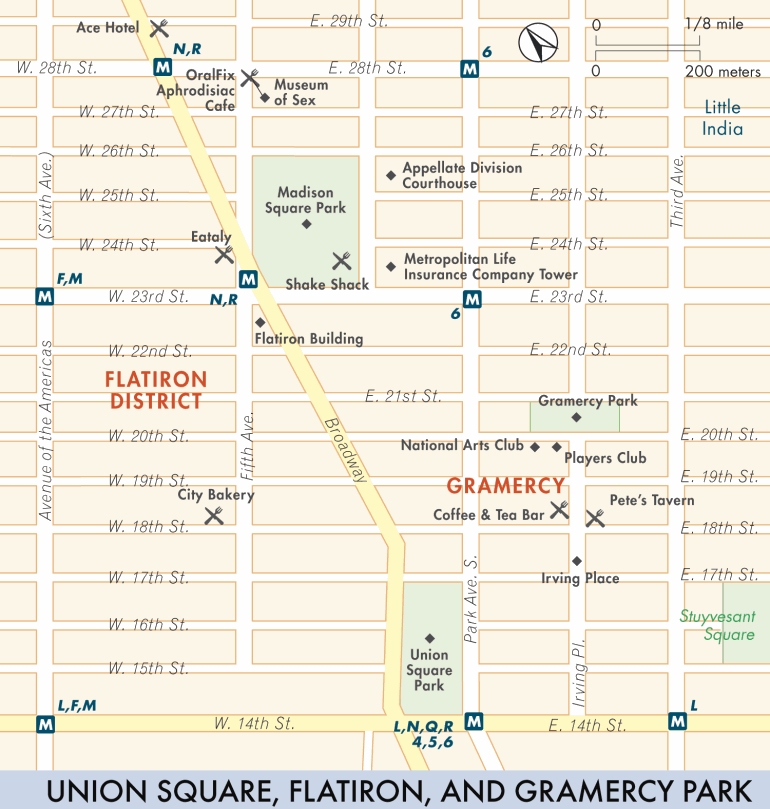
Student docents from Baruch College and New York University will point out and discuss famous and unique places next to litter cans in the Gramercy Flatiron including famous statues and unique places in Madison Sq. Park, eateries on 5th Ave, the farmers market in Union Square and Broadway, notable homes of Dutch, English and Americans in Gramercy Park

Following a brief discussion about the architectural importance of the Courthouse, students will then lead us through Madison Square Park, pointing out important statues and plaques, notable sculpture then down Broadway through Flatiron towards Union Sq. Park. The walk will then head north through Gramercy Park ending at the Vertical Campus of Baruch College at 25th Street and Lexington Ave.

The walk begins at 12pm on the front steps of the Appellate Division Courthouse of New York State adjacent to Madison Sq. Park. Bring questions, snacks, and curiosity. The walk will last about 90 minutes. If you want to learn more after the tour, stick around for a discussion about how it was designed – sign up here.

Baruch College and New York University students will present their results from mining the litter basket dataset available from NYC Open Data sources. Students will demonstrate how this data combination of other datasets to identify famous places, plaques, statues, trees and famous buildings in the Gramercy Flatiron neighborhoods.

These presentations will be based on data from the NYC Department of Sanitation, monuments and plaque datasets and tree census data from the NYC Parks Department. Students will discuss famous and unique places next to litter cans in the Gramercy Flatiron including famous statues and unique places in Madison Sq. Park, eateries on 5th Ave, the farmers market in Union Square and Broadway, notable homes of Dutch, English and Americans in Gramercy Park

Nothing to do with dumpster diving, but everything to do with leveraging unique data sets from NYC Open Data  the presentations will demonstrate how combining a myriad of datasets can drive new community gathering places and economic development.

Presentations begin at 1:30pm. Meet in front of the Baruch College Welcome Center at 137A East 25th Street. The building is located in a pedestrian plaza between 3rd Ave and Lexington Ave. Attendance is limited to 30 people. Please bring an ID card (like a driver’s license) that will allow you to get through security.

Before this discussion, join the related walking tour that starts at 12 p.m..

This session showcases the Brooklyn College Open Data Student Gallery, a publicly available resource featuring original civic research projects conducted by graduate students at Brooklyn College. Developed as part of a reproducible research curriculum, students used real NYC Open Data datasets to investigate questions that mattered to them — from public safety and housing trends to environmental and social issues affecting New Yorkers. Using R, Quarto, and the open-source nycOpenData package, each student produced a fully reproducible research chapter that is now published as part of an open educational resource. The gallery can be explored here:
https://martinezc1-nyc-open-data-student-gallery.share.connect.posit.cloud/.

The session will begin with a brief overview of how NYC Open Data was integrated into the classroom and how students moved from research question to public-facing publication. The majority of the session will feature short lightning talks from participating students, each presenting their project, dataset, analysis approach, and key findings. Attendees will gain insight into how real civic datasets can be used in higher education to build technical skills, critical thinking, and meaningful public scholarship.

This session is ideal for educators, civic technologists, students, and anyone interested in public data, reproducible research, or innovative teaching approaches. Participants will leave with concrete ideas for incorporating NYC Open Data into their own classrooms or projects — and examples of how student work can move beyond traditional assignments to become lasting, shareable contributions to the civic data ecosystem.

Childcare in the City is a free, student-led Open Data Week event exploring how NYC Open Data can power public storytelling and policy communication. Undergraduate students from Barnard College analyzed data from the NYC Work and Family Leave Survey and translated their findings into a short podcast featuring expert guests Dr. Meredith Slopen (Stony Brook University School of Social Welfare) and Dr. Jane Waldfogel (Compton Foundation Centennial Professor for the Prevention of Children’s and Youth Problems at Columbia University School of Social Work).

The event opens with a live listening of the student-produced podcast, followed by a moderated talkback with the graduate student mentors, student creators and expert guests. Together, they discuss their findings, the role of open data in civic life, and what the numbers reveal about childcare and family wellbeing in New York City—a timely topic given ongoing mayoral and gubernatorial conversations around universal childcare.

This 90-minute, in-person and virtual event is held on the Barnard College campus and is open to students, educators, researchers, and anyone interested in open data, storytelling, and family policy. Register here.

As part of NYC Open Data Week 2026, the CUNY Public Interest Technology (PIT) Lab will host a week-long Open Data Takeover of the NYC PIT Pop-Up at the Oculus / World Trade Center. The activation advances Open Data Week’s goals of accessibility, civic learning, and practical use of open data by bringing open data projects into a highly visible, public-facing space. Attendees can drop in at any time during the hours below for a demonstration of the tool and to speak with the presenter. Most of the demos will also be streamed live from the Pop-Up on its Twitch (https://www.twitch.tv/cunypitlab). Inside the Oculus, the Pop-Up is located on the Main Floor C2, in the South Concourse, at Shop #53 (next to M.A.C. Cosmetics). View the full PIT Lab schedule. No RSVP needed, just stop by!

[10am-1pm]
Lauri Goldkind – Drop-in Data Discussions & AI Dialogs for Real World Solutions
This is a one-day in-person drop-in, office hours style session aimed at human services professionals and similar public sector staff to learn about ways that Open Data and AI might be used to help their organizations, and to share experiences and challenges they currently face. The session will include hands-on activities and demos, educational materials, informal one-on-one discussions, group Q+A’s, and design activities. The first hour will include interactive table demonstrations of open data resources; the second hour will focus on the potential of AI capabilities for documenting impacts and improving organizational performance; the third hour will offer human services and local government agency staff the change to bring their data questions to office hours, meeting with like-minded colleagues, academics with domain expertise in data and AI literacy and student assistants.

[2pm-6pm]
Kierstin Gray – MindHeart AI: Developing Healing Technologies and Consensual Data Practices in the World of AI
MindHeart AI is a liberatory technology company centering the neuroscience of well being as a catalyst for intergenerational planetary healing. We create trauma-informed technologies that allow individuals to cultivate the necessary awareness to design sustainable pathways to well-being across personal, social, professional and collective communities. Utilizing the Systems Based Awareness Map, the world’s first interactive map of human awareness, we are building a scalable, equitable platform combined with experiences that we call MindHeart Activations – in-person events that support collective healing through combining culturally relevant forms of somatics, contemplative practices, land-based rituals and retreats, music and art, all designed to create an infrastructure of care as a loving response to our awareness of the rising loneliness, stress, isolation and depression experienced across the world.

Sasha Richardson – Black Knowledge Erasure Dataset
The Black Knowledge Erasure Dataset (BKED) is a research archive designed to document how AI models like GPT-5 and Gemini distort Black history and culture through specific “hallucinations”. Rather than viewing these errors as random bugs, the project frames them as “epistemic erasure,” where algorithms invent authorities or omit key figures in ways that mirror historical discrimination. The dataset includes the original prompts, the incorrect AI responses, and human-verified annotations that identify exactly where the models failed against standard archival sources.

Alex Conner – ººSPARK**CIVIC
ºSPARK**AI × ºDO..OS form the intelligence and operating layer behind ºSPARK**CIVIC’s NYC Data Week session, demonstrating how NYC Open Data can move from published datasets to shared understanding and clear next steps. ºSPARK**AI helps interpret complex civic data and policy context into consistent, plain-language meaning, while ºDO..OS ensures that guidance carries forward as reusable actions, templates, and handoffs across committees, agencies, partners, and the public.

This is a virtual hands-on workshop where we will dive in on spreadsheet fundamentals using Google Sheets through the lens of teaching virtual high school students. Participants who are new to spreadsheets and to those with intermediate skills are encouraged to attend, and those that teach high school students looking for a data lens. Participants will access a shared spreadsheet where we will learn about spreadsheets fundamentals together, and model how these skills can be taught to high school students. We will analyze a data set from NYC Open Data to apply the new functions we learn.

Ethel Khanis teaches high school chemistry and Socratic seminar at New York City’s first virtual high school.

Come to the NYC Office of Technology & Innovation offices at 2 MetroTech Center in Downtown Brooklyn for a series of lightning talks, each of which explores how open data interacts with aspects of everyday life. Afterwards, join us for a happy hour a few blocks away at Sound & Fury Brewery and Kitchen (141 Lawrence St, Brooklyn).

These lightning talks will cover projects on the price of groceries, picking public schools, deciding delivery routes, applying to city jobs and compliance for small property owners. Full details of the talks will be added as they get confirmed.

Andre Debuisne “Using Open Data to accurately generate hyperlocal delivery routes in NYC”
Hudson Shipping Co generates its own delivery routes using in-house optimization technology. Part of the input data comes from NYC Open Data, which helps the last-mile operator find the best route for a given day, based on road conditions, planned street closures and many other data points.

Adrian Liang “Applying to NYC’s public high schools by harnessing NYC Open Data resources”
Every year, over 70,000 NYC public middle school students take part in the high school application process. This involves researching and deciding what programs to list on applications from over 900 possible high school program choices. NYC-SIFT aggregates public data from over 20 different datasets found on NYC Open Data and NYC DOE InfoHub. This talk will include a discussion of relevant datasets, how this data is organized, and how students and parents use this data to make informed decisions during the high school application process.

Charles Ludwig “One Search, 4,000+ Careers: Unifying New York’s Public Sector Government Job Market”
Navigating public service careers shouldn’t require checking ten different websites. This talk explores the development of NY Gov Jobs, a unified platform that aggregates over 4,000 active salaried listings across NYC City agencies, New York State, CUNY, SUNY, the MTA, public health systems, and the NYPL. We’ll discuss the technical challenges of normalizing data from multiple jurisdictions and how a single, browser-friendly interface can democratize access to public sector employment.

Shiva Muthiah “PriceWise – A community-built grocery price database for budget-conscious people”
This talk will demo the tool PriceWise (https://www.pricewise.nyc) — a community database of food prices that helps people digitize purchase receipts and draws from NYC Open Data to connect them with stores and neighborhoods. As New Yorkers struggle with inflation, this tool aims to help them work together to pool pricing information.

Parris Taylor “From Transparency to Decision Infrastructure”
New York City has achieved something rare: a deeply structured, publicly accessible regulatory data ecosystem. But access is not the same as usability, and transparency is not the same as prevention. As an operator managing real assets in NYC, I’ve seen how DOB, HPD, FDNY, and DOF datasets remain difficult to operationalize for small property owners. Compliance still requires interpretation, coordination, and judgment across fragmented systems. This session explores how open data can evolve from static reporting to structured decision support. Using Brick, a compliance tool that helps identify regulations, as a case study, we will examine entity resolution across BBL and BIN identifiers and the role of AI in translating public datasets into building-specific risk signals and guided action.
In this session, we present projects from Maps @ MIXI, a mapping club about spatial justice, open data, and critical cartography. Throughout the year, five NYC youth worked on four projects during the club in which they analyzed NYC Open Data and other open data sets like the US Census. The projects span a variety of topics – access to pools, the housing crisis, restaurant hygiene ratings, and youth-targeting police activity. The projects are youth-driven and represent the questions youth bring to open data.

First, this will briefly introduce the Maps @ MIXI club. Then, each youth/team will briefly discuss their project, the motivation behind the work, and the map they created.

Unequal Pool Distribution Around NYC and How It Affects Overall Public Health by Zachary Kiselev
How can we use NYC Open Data to understand whether pool access is unevenly distributed between neighborhoods, and how can this be used as a marker for overall public health?

Using NYC Open Data to Understand the Causes of New York City’s Housing Crisis by Oleksandra Borysova
How can NYC Open Data show why NYC has a housing crisis by looking at vacancy, rents, wages, population changes, transportation, and Airbnb listings?

Predicting Restaurant Hygiene Grades Across New York City by Gab Dechirico and Mariam Khan
In New York City, to what extent do neighborhood socioeconomic indicators and cuisine types predict a restaurant’s likelihood of receiving an “A” hygiene grade, after accounting for inspection frequency and violation patterns?

Policing and Youth: Analyzing Police Stops of Youth in New York City by Wen Chen
How does the racial composition of youth subjected to police stops within 700 feet of NYC public schools differ from the racial composition of youth residing in the surrounding census tracts?

Unlock the secrets of the city in this interactive data treasure hunt! We will present a series of data-driven prompts guiding attendees through unique statistical signatures found in NYC Open Data covering topics like taxis, crime, schools, and parks. Participants will spend the session solving progressively difficult analytical questions, requiring everything from simple lookups to complex cross-referencing across datasets.

As we discuss the answer to each prompt, a panel of experts from the New York City Chapter of The American Statistical Association will take the investigation one step deeper, presenting a bite-sized lesson on a statistical concept related to the question. Attendees will learn about tools that can be adapted to many other settings, such as distributional thinking, outlier detection, hypothesis testing, and exploratory data analysis. The session culminates in a final puzzle: figuring out the hidden theme that connects all the mystery answers together. This session is ideal for data scientists, students, civic tech enthusiasts, or anyone looking to sharpen their analytical toolkit, open data scientific educational opportunity for all, undergraduate and graduate students very welcome.