In this session, David Tussey — retired technology executive and former executive director in the NYC Department of Information Technology and Telecommunications (DoITT, now OTI) — presents a data-driven Quality of Life Index built entirely from NYC’s 311 Service Request open dataset. Drawing on more than 13 million complaint records spanning 2020 through 2025, the analysis tracks 30 complaint categories across five quality-of-life domains — from shelter conditions and neighborhood cleanliness to street safety and social distress — and measures how each has changed relative to a pre-established baseline. The methodology, developed with guidance from mentor Dr. Jun Yan of the University of Connecticut Department of Statistics, applies seasonally adjusted indexing and Statistical Process Control techniques to surface meaningful trends in public service demand.

Participants will see a live walkthrough of the analytical pipeline built in R using NYC Open Data, including data preparation, index computation, and publication-ready visualizations. The session is part demonstration, part methodology discussion, and part provocation — the findings raise real questions about urban quality of life that city agencies, policymakers, and engaged New Yorkers will want to wrestle with.

This session is ideal for city employees working in technology or data roles, academics and students interested in applied urban analytics, and anyone curious about what 311 data can reveal when you look beyond individual complaints. No prior technical background is required to follow the findings, though data practitioners will find the methodology discussion valuable. Attendees are encouraged to come with questions.

We’ve all seen construction sites and scaffolding appear in our neighborhood, tried to peek through the cracks and wondered: what are they building over there? This presentation will showcase how publicly available NYC Department of Buildings data can be brought together and deployed to give New Yorkers and industry pros alike a birds eye view on what’s rising up in their communities, all at once and at a glance!

Join Bonnie Stefanick, New Yorker and citizen data scientist, through a high level overview of how the things that get built show up in permitting data using live demonstrations of data sets that capture the permitting process and a daily view of projects happening in NYC neighborhoods, while giving a peek under the hood at the data in action from how it is pulled from the open data APIs and brought to life in tools.

As part of NYC Open Data Week 2026, the CUNY Public Interest Technology (PIT) Lab will host a week-long Open Data Takeover of the NYC PIT Pop-Up at the Oculus / World Trade Center. The activation advances Open Data Week’s goals of accessibility, civic learning, and practical use of open data by bringing open data projects into a highly visible, public-facing space. Attendees can drop in at any time during the hours below for a demonstration of the tool and to speak with the presenter. Most of the demos will also be streamed live from the Pop-Up on its Twitch (https://www.twitch.tv/cunypitlab). Inside the Oculus, the Pop-Up is located on the Main Floor C2, in the South Concourse, at Shop #53 (next to M.A.C. Cosmetics). View the full PIT Lab schedule. No RSVP needed, just stop by!

[2pm-6pm]
Masaru Kakutani – From Data to Action: Addressing NYC Winter Heating Complaints with Data Visualization
I want to show how anyone interested in actionable policy can, with the help of generative AI, quickly create convincing stories. This demonstration is designed to help anyone who is interested in generating clear policy suggestions using NYC Data. A standard generative AI will assist in developing policy suggestions, but the template ensures that the AI provides only support, not direction or guidance, for those interested in creating policies.

Lisa Mae Fielder – MTA Performance Metrics
The MTA’s dashboard, metrics.mta.info, which is built entirely off of open data, is going through a major redesign in 2026. We’d like to collect user feedback to better understand features and visuals that the civic tech community would want.

Michael Freedman – crashcount.nyc: an open data tool for safe-streets advocacy
Crashcount.nyc is a public, open-data–driven tool that uses NYC Open Data and AI to document and contextualize traffic crashes involving pedestrians and cyclists, with the goal of supporting safer-streets advocacy at the neighborhood and district level. This session will demonstrate how publicly available NYC datasets—particularly traffic crash data—can be transformed into clear, actionable narratives that help communities understand where traffic violence is increasing and how it relates to policy decisions, street design, and enforcement. The presentation will walk through the structure of Crashcount.nyc, the datasets it relies on, and the design decisions behind presenting complex data in a way that is usable by advocates, journalists, and community members without technical backgrounds.

Street tree planting delivers well-documented environmental and public health benefits, but it also interacts with housing markets in complex ways. This virtual session uses open data to explore how urban greening strategies may shape housing prices and rents in New York City.

Drawing on NYC Open Data and other publicly available housing, demographic, and environmental datasets, the presentation will walk through the data sources, modeling approach, and key findings of this analysis. The session also features a live demonstration of a web-based interactive simulation tool that allows participants to explore different tree-planting scenarios and their potential market impacts, supporting more informed, transparent, and equitable decision-making around urban greening investments. This session is designed for planners, policymakers, researchers, advocates, and community members. No technical background is required.

The project is led by Dr. Hanxue Wei, Industry Assistant Professor at NYU’s Center for Urban Science + Progress (CUSP). Archy Guo, Graduate Research Assistant at CUSP, is leading the presentation and conducting the core analytical work. The project team also includes Dr. Max Vilgalys, Climate Policy Analyst at NYC Office of Management and Budget, and Dr. Alex Azan, Assistant Professor at NYU Langone Health.

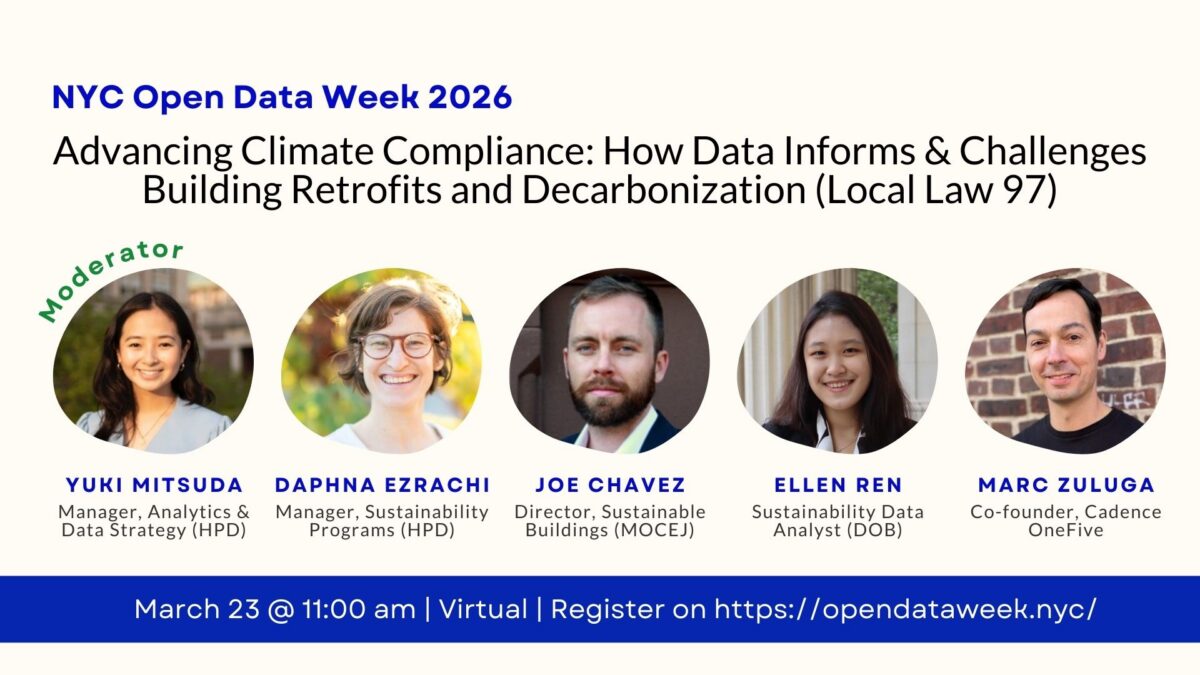
Local Law 97 of 2019 is one of the nation’s most ambitious climate laws, setting carbon emissions limits for most large buildings across New York City. As the first major compliance deadlines take effect, data has become a central driver—shaping how agencies, nonprofits, and building owners understand performance, identify risks, and plan for long-term decarbonization.

This session brings together experts from city agencies and the private sector partners to explore how open data and public datasets are transforming the city’s approach to building emissions. Speakers from NYC Housing Preservation & Development (HPD), the Department of Buildings (DOB), the Mayor’s Office of Climate & Environmental Justice (MOCEJ), and Cadence OneFive will share how their organizations use data to implement the law, monitor energy usage, model carbon impacts, develop compliance services, and design equitable climate strategies.

Professionals, civic technologists, and the general public who are interested in the role of data in climate resiliency, building decarbonization, affordable housing, and climate policy will most benefit from attending this session.

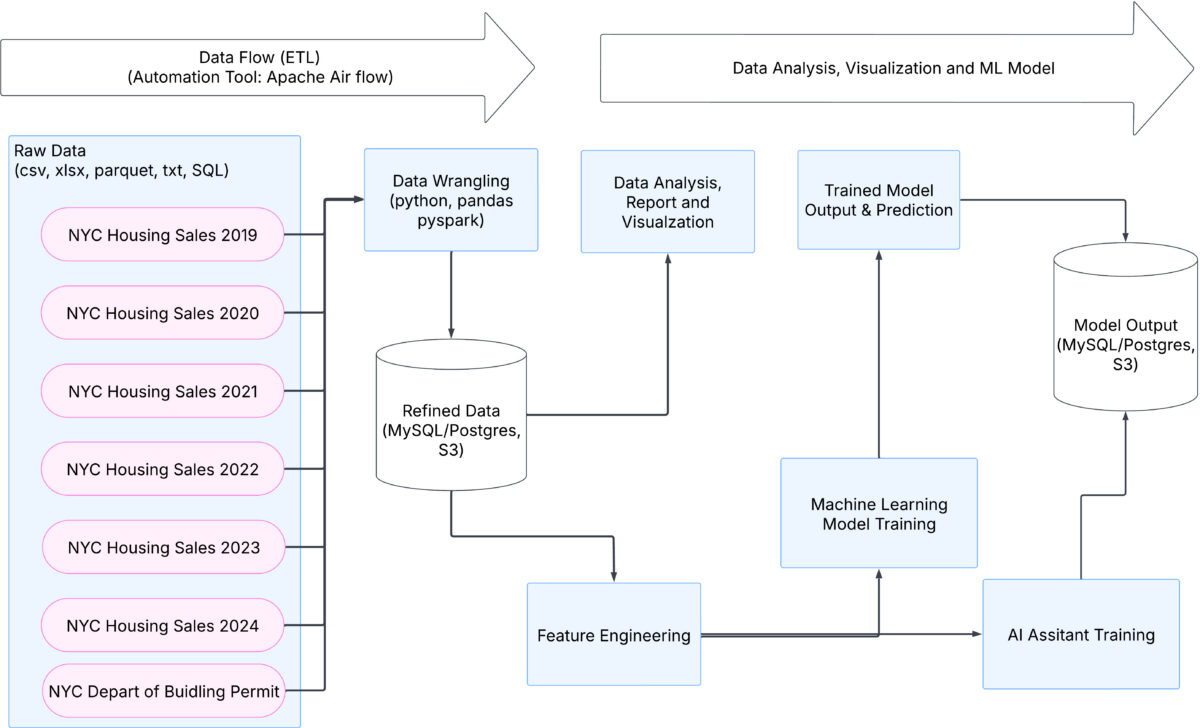
This session explores advanced analysis of NYC residential property sales (2019–2024) using NYC Open Data, with a focus on model improvement and AI integration. Researchers Yue Ru Li and Chunhong Zhao will demonstrate how combining Department of Finance sales data with Department of Buildings permit data can enhance predictive performance. Participants will work through a hands-on Python notebook covering feature engineering, data visualization, and machine learning models, while also learning how an embedded AI assistant can streamline data cleaning, feature generation, and model interpretation.

Join Census Bureau data dissemination specialists Joli Golden and David Kraiker to learn how to use data.census.gov to access the most current and relevant demographic, socioeconomic, and housing statistics about your community. During this presentation, you will learn about the Decennial Census, the American Community Survey (ACS) and other Census Bureau programs, geographies, and datasets. Plus, you will see live demonstrations of the search and navigation features in data.census.gov as well as how to download tables, create charts and generate thematic maps. This training is recommended for all data users.