Did you know that NYC Emergency Management (NYCEM) uses data to analyze disasters and their impacts to communities across the five boroughs? This session explores how NYCEM’s recovery dashboard assesses disaster damage to identify recovery solutions and funding pathways in real time. The presentation also spotlights NYCEM’s Hazard History and Consequence Tool (HHC), a resource that gives City agencies and community partners access to historical data to better understand past hazard events to strengthen future resilience planning.

Do you look up as you walk through our city, curious about the trees? Join this interactive session exploring the NYC Tree Map, a free online tool developed by NYC Parks. We’ll hear from the deputy director of Digital Media at NYC Parks, Tom Hughes, about how the NYC Tree Map was designed and developed. You’ll then have time to use desktop computers to explore the NYC Tree Map and become familiar with navigating its features. We’ll conclude by hearing from members of the Jackson Heights Beautification Group Tree LC Team about how they utilize this tool to organize and record their tree stewardship efforts.

This event will be held at the St. John’s Recreation Center (1251 Prospect Place) in Brooklyn. Register here.

In this session, David Tussey — retired technology executive and former executive director in the NYC Department of Information Technology and Telecommunications (DoITT, now OTI) — presents a data-driven Quality of Life Index built entirely from NYC’s 311 Service Request open dataset. Drawing on more than 13 million complaint records spanning 2020 through 2025, the analysis tracks 30 complaint categories across five quality-of-life domains — from shelter conditions and neighborhood cleanliness to street safety and social distress — and measures how each has changed relative to a pre-established baseline. The methodology, developed with guidance from mentor Dr. Jun Yan of the University of Connecticut Department of Statistics, applies seasonally adjusted indexing and Statistical Process Control techniques to surface meaningful trends in public service demand.

Participants will see a live walkthrough of the analytical pipeline built in R using NYC Open Data, including data preparation, index computation, and publication-ready visualizations. The session is part demonstration, part methodology discussion, and part provocation — the findings raise real questions about urban quality of life that city agencies, policymakers, and engaged New Yorkers will want to wrestle with.

This session is ideal for city employees working in technology or data roles, academics and students interested in applied urban analytics, and anyone curious about what 311 data can reveal when you look beyond individual complaints. No prior technical background is required to follow the findings, though data practitioners will find the methodology discussion valuable. Attendees are encouraged to come with questions.

As part of NYC Open Data Week 2026, the CUNY Public Interest Technology (PIT) Lab will host a week-long Open Data Takeover of the NYC PIT Pop-Up at the Oculus / World Trade Center. The activation advances Open Data Week’s goals of accessibility, civic learning, and practical use of open data by bringing open data projects into a highly visible, public-facing space. Attendees can drop in at any time during the hours below for a demonstration of the tool and to speak with the presenter. Most of the demos will also be streamed live from the Pop-Up on its Twitch (https://www.twitch.tv/cunypitlab). Inside the Oculus, the Pop-Up is located on the Main Floor C2, in the South Concourse, at Shop #53 (next to M.A.C. Cosmetics). View the full PIT Lab schedule. No RSVP needed, just stop by!

[2pm-6pm]
Nate Cooper – Space Apps Showcase
In this session, learn about the NASA Space Apps Challenge, NASA’s global data hackathon. Each year NASA posts 11 challenges to use its data in unique ways over the course of a weekend. Last year, there were over 100k participants globally. You’ll meet participants from last year’s hackathon including winning teams, judges, and mentors from the NYC local site. What does it take to turn an open data set into something useful, fun, and engaging? Learn what happened, what projects are still being developed, and how to build your own solutions using NASA’s data. Following a presentation, we’ll do a hands-on workshop so you can learn how to build your own open data app.

As part of NYC Open Data Week 2026, the CUNY Public Interest Technology (PIT) Lab will host a week-long Open Data Takeover of the NYC PIT Pop-Up at the Oculus / World Trade Center. The activation advances Open Data Week’s goals of accessibility, civic learning, and practical use of open data by bringing open data projects into a highly visible, public-facing space. Attendees can drop in at any time during the hours below for a demonstration of the tool and to speak with the presenter. Most of the demos will also be streamed live from the Pop-Up on its Twitch (https://www.twitch.tv/cunypitlab). Inside the Oculus, the Pop-Up is located on the Main Floor C2, in the South Concourse, at Shop #53 (next to M.A.C. Cosmetics). View the full PIT Lab schedule. No RSVP needed, just stop by!

[10am-1pm]
Lauri Goldkind – Drop-in Data Discussions & AI Dialogs for Real World Solutions
This is a one-day in-person drop-in, office hours style session aimed at human services professionals and similar public sector staff to learn about ways that Open Data and AI might be used to help their organizations, and to share experiences and challenges they currently face. The session will include hands-on activities and demos, educational materials, informal one-on-one discussions, group Q+A’s, and design activities. The first hour will include interactive table demonstrations of open data resources; the second hour will focus on the potential of AI capabilities for documenting impacts and improving organizational performance; the third hour will offer human services and local government agency staff the change to bring their data questions to office hours, meeting with like-minded colleagues, academics with domain expertise in data and AI literacy and student assistants.

[2pm-6pm]
Kierstin Gray – MindHeart AI: Developing Healing Technologies and Consensual Data Practices in the World of AI
MindHeart AI is a liberatory technology company centering the neuroscience of well being as a catalyst for intergenerational planetary healing. We create trauma-informed technologies that allow individuals to cultivate the necessary awareness to design sustainable pathways to well-being across personal, social, professional and collective communities. Utilizing the Systems Based Awareness Map, the world’s first interactive map of human awareness, we are building a scalable, equitable platform combined with experiences that we call MindHeart Activations – in-person events that support collective healing through combining culturally relevant forms of somatics, contemplative practices, land-based rituals and retreats, music and art, all designed to create an infrastructure of care as a loving response to our awareness of the rising loneliness, stress, isolation and depression experienced across the world.

Sasha Richardson – Black Knowledge Erasure Dataset
The Black Knowledge Erasure Dataset (BKED) is a research archive designed to document how AI models like GPT-5 and Gemini distort Black history and culture through specific “hallucinations”. Rather than viewing these errors as random bugs, the project frames them as “epistemic erasure,” where algorithms invent authorities or omit key figures in ways that mirror historical discrimination. The dataset includes the original prompts, the incorrect AI responses, and human-verified annotations that identify exactly where the models failed against standard archival sources.

Alex Conner – ººSPARK**CIVIC
ºSPARK**AI × ºDO..OS form the intelligence and operating layer behind ºSPARK**CIVIC’s NYC Data Week session, demonstrating how NYC Open Data can move from published datasets to shared understanding and clear next steps. ºSPARK**AI helps interpret complex civic data and policy context into consistent, plain-language meaning, while ºDO..OS ensures that guidance carries forward as reusable actions, templates, and handoffs across committees, agencies, partners, and the public.

As part of NYC Open Data Week 2026, the CUNY Public Interest Technology (PIT) Lab will host a week-long Open Data Takeover of the NYC PIT Pop-Up at the Oculus / World Trade Center. The activation advances Open Data Week’s goals of accessibility, civic learning, and practical use of open data by bringing open data projects into a highly visible, public-facing space. Attendees can drop in at any time during the hours below for a demonstration of the tool and to speak with the presenter. Most of the demos will also be streamed live from the Pop-Up on its Twitch (https://www.twitch.tv/cunypitlab). Inside the Oculus, the Pop-Up is located on the Main Floor C2, in the South Concourse, at Shop #53 (next to M.A.C. Cosmetics). View the full PIT Lab schedule. No RSVP needed, just stop by!

[2pm-6pm]
Sneha Srivastava – What’s Lost in the Waters? Dive into NYC’s Flood Vulnerability Index
The goal of this project is to visualize the variables included in New York City’s Flood Vulnerability Index dataset. The key visualization is a three-dimensional interactive model, mapping the Flood Susceptibility to Harm and Recovery Index against the median household income of each census tract within the city, in addition to maps of future flooding scenarios. As such, the project tackles issues of environmental justice and sustainability, while addressing the policy implications of climate resilience in different neighborhoods.

The Cloud is a Place in Brooklyn
In this speculative design workshop, we ask: What if our data infrastructure lived in our neighborhood parks, schools, or community gardens? What if a data center didn’t just store files, but also used its excess heat to warm a public pool in the winter? What if your neighborhood’s digital history was stored in a “Community Memory Bank” that you helped manage? What if data infrastructure was owned by communities and served community needs?

Apurva Jhamb – Brooklyn Through Data Design : Mapping Place, Power, and Urban Systems
Centered on Brooklyn, the event will showcase a series of data-driven maps and visual narratives created using NYC Open Data datasets related to housing, land use, landmarks, environmental conditions, and neighborhood change. The session will demonstrate how public data when paired with thoughtful design can move beyond technical analysis to become an accessible storytelling tool for communities, planners, designers, and civic technologists.

A workshop that uses NYC Open Data to map green space access gaps, not just where parks exist, but who can actually reach them. We’ll identify transit barriers, unsafe pedestrian routes, and vacant lots with conversion potential, then equip participants with concrete tools to turn that analysis into community advocacy.

The core question isn’t whether parks are near enough, it’s whether people can access them. A park two miles away with no bus route might as well not exist for the people who need it most. Participants will learn to map those gaps and identify actionable solutions: Which bus route needs extending? Which vacant lot could become a neighborhood green space? Which crosswalk is missing? This workshop is about democratizing spatial analysis so that communities, not just planners, have the data to advocate for themselves.

By the end, participants will have learned what it takes to create a working map of access gaps in a neighborhood of their choosing, a set of targeted recommendations, and guidance on how to present that data to the decision-makers who can act on it.

This event will be held at the Little Red School House, 272 Avenue of the Americas.

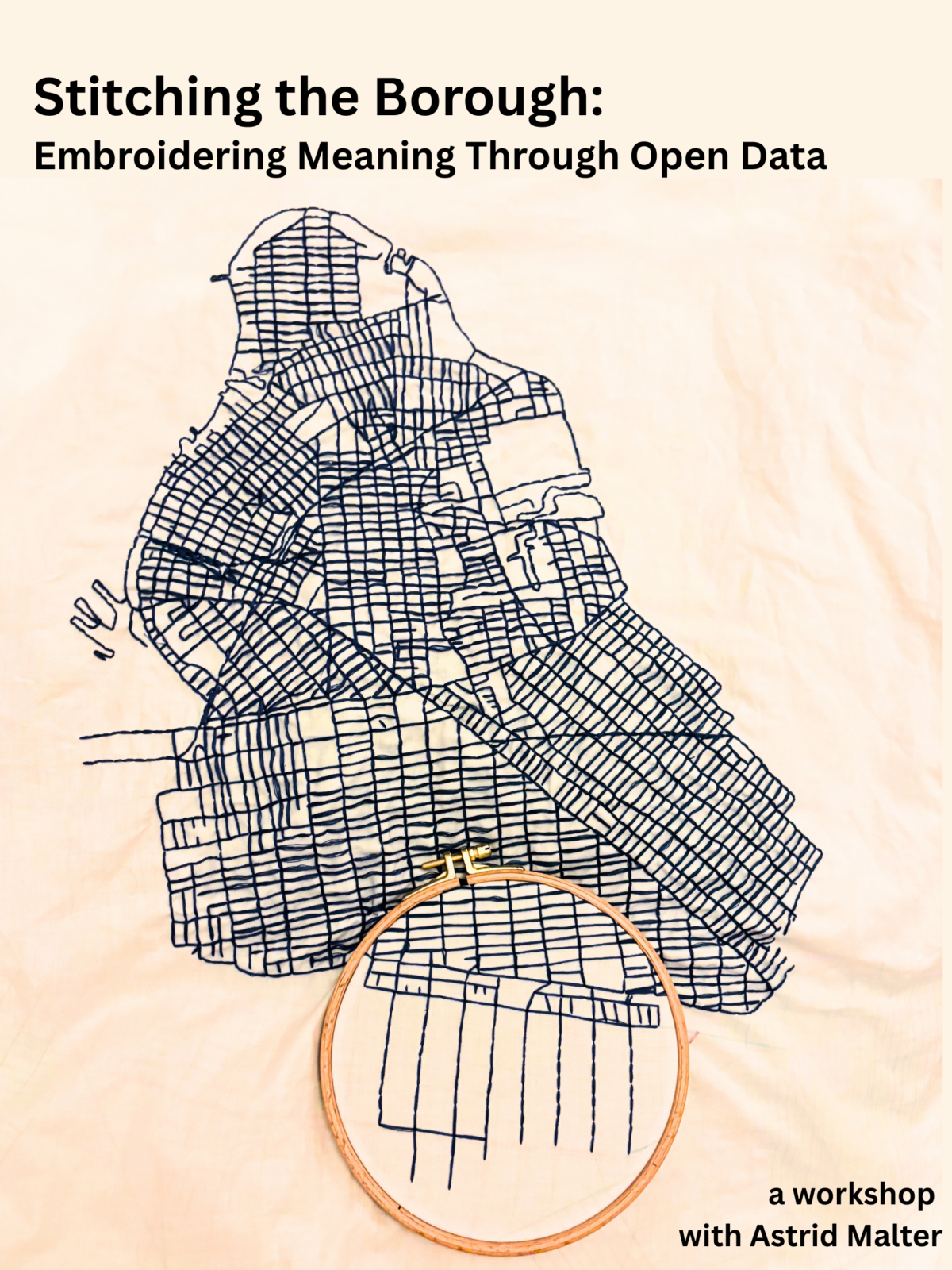
Join artist Astrid Malter at BRIC for an introductory embroidery workshop and create your own meaningful map using NYC’s Open Data. In the first half of this workshop, Astrid will give a presentation on her methods and the data behind her hand-stitched map of Brooklyn that compares the location of MTA bus stop shelters to the Heat Vulnerability Index. The second half of the workshop will give participants time to learn basic embroidery techniques and explore making art with a public dataset of their choosing.

This event is open to beginners and all embroidery materials will be provided. If possible, participants should bring a phone, tablet, or computer to access public datasets.

Street tree planting delivers well-documented environmental and public health benefits, but it also interacts with housing markets in complex ways. This virtual session uses open data to explore how urban greening strategies may shape housing prices and rents in New York City.

Drawing on NYC Open Data and other publicly available housing, demographic, and environmental datasets, the presentation will walk through the data sources, modeling approach, and key findings of this analysis. The session also features a live demonstration of a web-based interactive simulation tool that allows participants to explore different tree-planting scenarios and their potential market impacts, supporting more informed, transparent, and equitable decision-making around urban greening investments. This session is designed for planners, policymakers, researchers, advocates, and community members. No technical background is required.

The project is led by Dr. Hanxue Wei, Industry Assistant Professor at NYU’s Center for Urban Science + Progress (CUSP). Archy Guo, Graduate Research Assistant at CUSP, is leading the presentation and conducting the core analytical work. The project team also includes Dr. Max Vilgalys, Climate Policy Analyst at NYC Office of Management and Budget, and Dr. Alex Azan, Assistant Professor at NYU Langone Health.

UnSchool of Data is BetaNYC’s open space unconference for networking, co-creating, and learning. It brings together city residents, technologists, civic leaders, students, advocates, policy nerds, government staff, elected officials, journalists, designers, and more to leverage open data to tackle some of the most pressing issues in NYC and beyond.

It’s a community driven day for turning open data into civic solutions.

UnSchool of Data has these underlying goals:

  1. Convene community members to share civic insights and ideas.
  2. Create processes/projects that people will use for further action.
  3. Foster formal and informal communities of practice and action.

Learn more about UnSchool of Data and how it works at www.schoolofdata.nyc/unschool.