Come to the NYC Office of Technology & Innovation offices at 2 MetroTech Center in Downtown Brooklyn for a series of lightning talks, each of which explores how open data interacts with aspects of everyday life. Afterwards, join us for a happy hour a few blocks away at Sound & Fury Brewery and Kitchen (141 Lawrence St, Brooklyn).

These lightning talks will cover projects on the price of groceries, picking public schools, deciding delivery routes, applying to city jobs and compliance for small property owners. Full details of the talks will be added as they get confirmed.

Andre Debuisne “Using Open Data to accurately generate hyperlocal delivery routes in NYC”
Hudson Shipping Co generates its own delivery routes using in-house optimization technology. Part of the input data comes from NYC Open Data, which helps the last-mile operator find the best route for a given day, based on road conditions, planned street closures and many other data points.

Adrian Liang “Applying to NYC’s public high schools by harnessing NYC Open Data resources”
Every year, over 70,000 NYC public middle school students take part in the high school application process. This involves researching and deciding what programs to list on applications from over 900 possible high school program choices. NYC-SIFT aggregates public data from over 20 different datasets found on NYC Open Data and NYC DOE InfoHub. This talk will include a discussion of relevant datasets, how this data is organized, and how students and parents use this data to make informed decisions during the high school application process.

Charles Ludwig “One Search, 4,000+ Careers: Unifying New York’s Public Sector Government Job Market”
Navigating public service careers shouldn’t require checking ten different websites. This talk explores the development of NY Gov Jobs, a unified platform that aggregates over 4,000 active salaried listings across NYC City agencies, New York State, CUNY, SUNY, the MTA, public health systems, and the NYPL. We’ll discuss the technical challenges of normalizing data from multiple jurisdictions and how a single, browser-friendly interface can democratize access to public sector employment.

Shiva Muthiah “PriceWise – A community-built grocery price database for budget-conscious people”
This talk will demo the tool PriceWise (https://www.pricewise.nyc) — a community database of food prices that helps people digitize purchase receipts and draws from NYC Open Data to connect them with stores and neighborhoods. As New Yorkers struggle with inflation, this tool aims to help them work together to pool pricing information.

Parris Taylor “From Transparency to Decision Infrastructure”
New York City has achieved something rare: a deeply structured, publicly accessible regulatory data ecosystem. But access is not the same as usability, and transparency is not the same as prevention. As an operator managing real assets in NYC, I’ve seen how DOB, HPD, FDNY, and DOF datasets remain difficult to operationalize for small property owners. Compliance still requires interpretation, coordination, and judgment across fragmented systems. This session explores how open data can evolve from static reporting to structured decision support. Using Brick, a compliance tool that helps identify regulations, as a case study, we will examine entity resolution across BBL and BIN identifiers and the role of AI in translating public datasets into building-specific risk signals and guided action.


In this session, we present projects from Maps @ MIXI, a mapping club about spatial justice, open data, and critical cartography. Throughout the year, five NYC youth worked on four projects during the club in which they analyzed NYC Open Data and other open data sets like the US Census. The projects span a variety of topics – access to pools, the housing crisis, restaurant hygiene ratings, and youth-targeting police activity. The projects are youth-driven and represent the questions youth bring to open data.

First, this will briefly introduce the Maps @ MIXI club. Then, each youth/team will briefly discuss their project, the motivation behind the work, and the map they created.

Unequal Pool Distribution Around NYC and How It Affects Overall Public Health by Zachary Kiselev
How can we use NYC Open Data to understand whether pool access is unevenly distributed between neighborhoods, and how can this be used as a marker for overall public health?

Using NYC Open Data to Understand the Causes of New York City’s Housing Crisis by Oleksandra Borysova
How can NYC Open Data show why NYC has a housing crisis by looking at vacancy, rents, wages, population changes, transportation, and Airbnb listings?

Predicting Restaurant Hygiene Grades Across New York City by Gab Dechirico and Mariam Khan
In New York City, to what extent do neighborhood socioeconomic indicators and cuisine types predict a restaurant’s likelihood of receiving an “A” hygiene grade, after accounting for inspection frequency and violation patterns?

Policing and Youth: Analyzing Police Stops of Youth in New York City by Wen Chen
How does the racial composition of youth subjected to police stops within 700 feet of NYC public schools differ from the racial composition of youth residing in the surrounding census tracts?

New York City agencies create and publish a huge volume of geospatial data each year. They use Geographic Information Systems (GIS) – computer-based tools to store, visualize, and analyze this geographic data. This panel will review publicly-available tools and datasets, discuss the state of GIS technology in the city, and consider how the City uses geospatial data to serve NYC residents.  Join this conversation with agency GIS leaders about new maps & tools, geospatial data, and initiatives for 2026.

Moderator
Lee Ilan, NYC Mayor’s Office of Environmental Remediation

Panelists
Josh Friedman, NYC Emergency Management
Matt Croswell, NYC Department of City Planning
Adam Barin, NYC Mayor’s Office of Operations

UnSchool of Data is BetaNYC’s open space unconference for networking, co-creating, and learning. It brings together city residents, technologists, civic leaders, students, advocates, policy nerds, government staff, elected officials, journalists, designers, and more to leverage open data to tackle some of the most pressing issues in NYC and beyond.

It’s a community driven day for turning open data into civic solutions.

UnSchool of Data has these underlying goals:

  1. Convene community members to share civic insights and ideas.
  2. Create processes/projects that people will use for further action.
  3. Foster formal and informal communities of practice and action.

Learn more about UnSchool of Data and how it works at www.schoolofdata.nyc/unschool.

Join Paul Reeping, Director of Research at Vital City, for an interactive session exploring Vital City’s new Crime Data Explorer, a multi-decade, precinct-level platform covering complaints, arrests, and shootings in New York City. Paul will demonstrate how the tool works, explain the analytic framework behind it, and highlight key findings from Vital City’s most recent end-of-year crime report. Participants will gain a clearer understanding of long-term crime trends, how different categories are measured, and how to responsibly interpret citywide and neighborhood-level data.

The session will also look ahead. After walking through the Explorer, Paul will preview upcoming data initiatives at Vital City and invite participants to help shape future tools for data visualization, public safety measurement, and open data accessibility. This event is ideal for researchers, journalists, policymakers, technologists, students, and anyone interested in understanding crime trends and building better public data tools. Expect a mix of live demonstration, substantive analysis, and collaborative discussion about what New York City should measure, visualize, and build next.

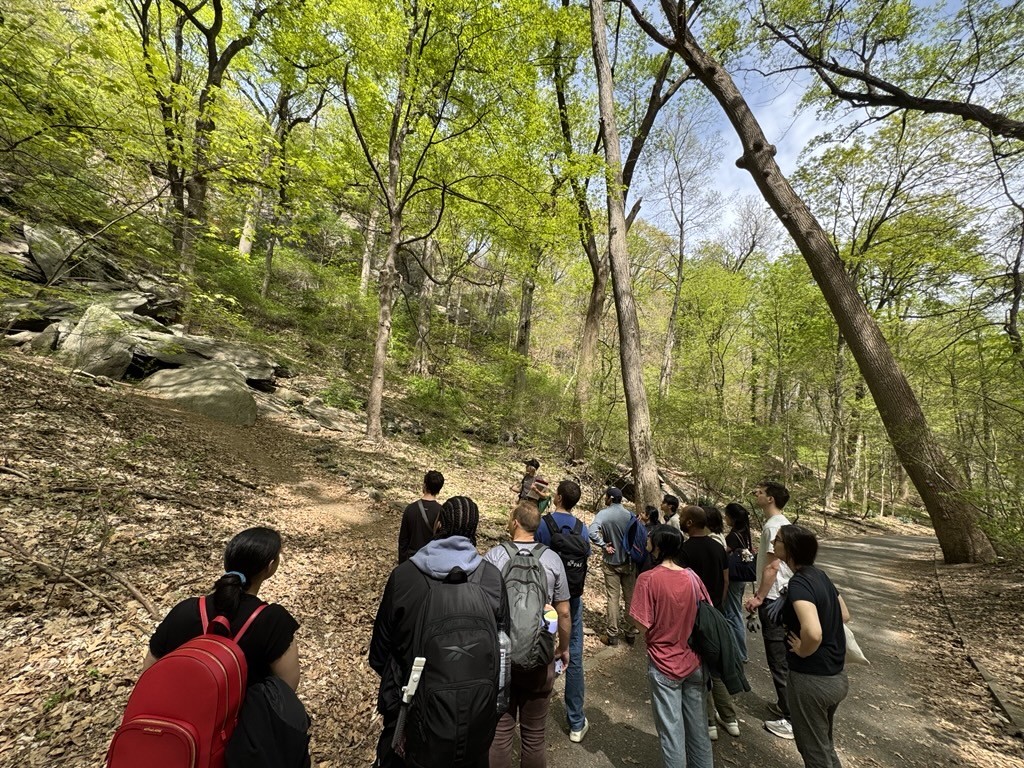
Join NYC Parks and Macaulay Honors College for an evening bioblitz at Inwood Hill Park, which is part of the Old-Growth Forest Network and accessible via subway. Tina Cuevas, natural areas outreach coordinator at NYC Parks, will discuss restoration activities within NYC Parks and how monitoring plays a large part in how Parks works within our city’s natural areas and beyond. Kelly O’Donnell, lead NYC organizer for City Nature Challenge & director of Science Forward at Macaulay Honors College, will contextualize the data that iNaturalist captures and becomes part of a larger global dataset that helps scientists with their research all over the globe.

Participants will learn how to use the iNaturalist app to take data observations of local plants and wildlife. They will be able to learn how to lead their own bioblitzes and engage with the iNaturalist community and at City Nature Challenge in April as well. Part of this will also be a walk to discuss plants that may be emerging in early spring, a discussion on local park history, and about projects that may have used iNaturalist data. Come dressed in sturdy boots or shoes, long sleeves, long pants, and clothing that can get dirty.

The meeting point for this event will be the Payson Playground at Inwood Hill Park, 285-287 Dyckman St, New York, NY 10034

New York City’s food supply chain relies on a distribution system dependent on diesel trucks, creating compounding environmental and economic burdens in the South Bronx. This session, hosted by independent researcher Dan DeWitz, examines Hunts Point—home to the city’s largest wholesale food distribution hub—through the intersecting lenses of air quality, poverty, and climate risk. Participants will learn to critically evaluate environmental data, test the statistical significance of neighborhood-level air quality differences, and understand the limitations of relying on existing monitoring systems as “ground truth.”

Looking forward, the session explores policy alternatives to the current model. By mapping Metro-North and LIRR rail lines alongside regional farmland and underserved communities, we will examine the untapped potential of existing transit infrastructure to reduce diesel emissions and improve food access. With portions of Hunts Point projected to flood under future climate scenarios, change is not just desirable—it is inevitable.

This event is ideal for anyone interested in environmental justice, urban planning, transportation policy, food systems, or applied data science. Whether you are a community advocate, policymaker, student, or curious New Yorker, you will leave with a deeper understanding of the data behind urban inequality and practical frameworks for solutions.

How can we use publicly available data to understand well-being, need, and resource gaps in NYC? In this interactive session, Alex Powers, Kate Harvey, and Tara Shawa from Measure of America will demonstrate DATA2GO.NYC, a free, easy-to-use online mapping and data tool. This platform aggregates over 400 indicators from federal, state, and NYC sources, allowing users to explore neighborhood-level insights on everything from health and housing to digital equity. Participants will see firsthand how to use change-over-time views and demographic breakdowns to drive informed decision-making and advocacy in their communities.

This event is designed for anyone interested in leveraging data for social impact. The session will begin with an introduction and overview of the tool’s capabilities, followed by an engaging “Data Bingo” competition. This interactive activity provides hands-on experience, allowing participants to explore the tool in small groups and practice extracting relevant insights in real-time. Whether you are a data novice or a seasoned data deckhand, you will leave with an enhanced ability to set sail on the vast sea of NYC data and better understand the well-being of New Yorkers.

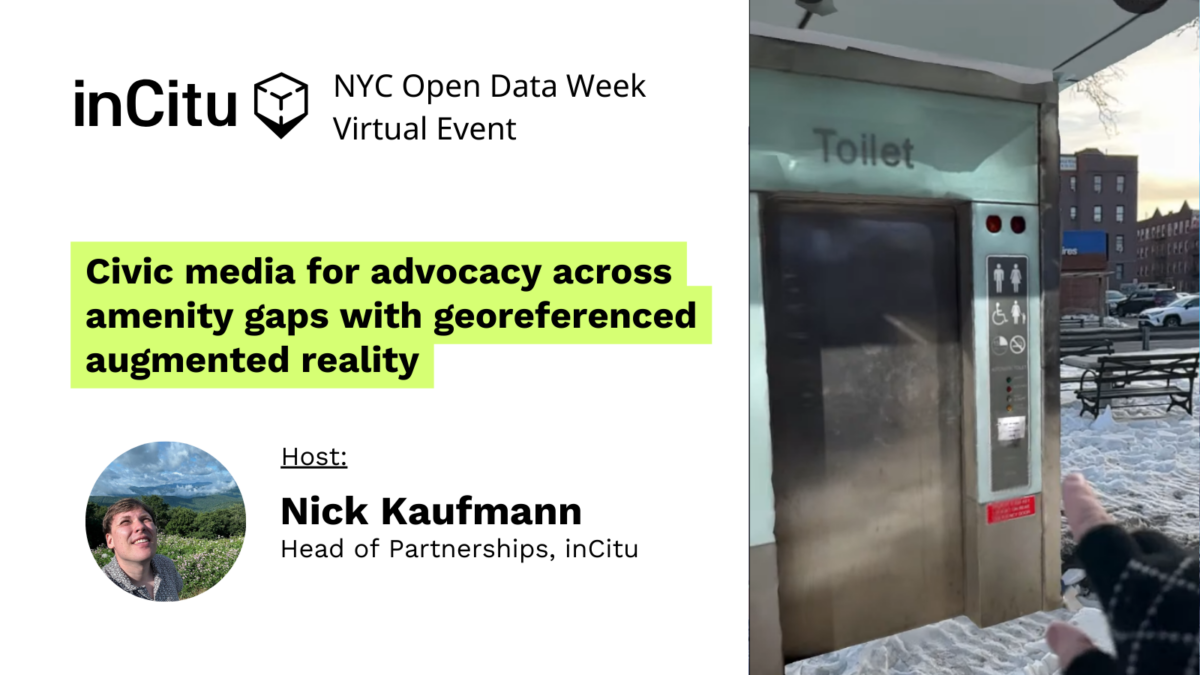
While initiatives like Mapping for Equity document what exists (or doesn’t exist) in public spaces, these gaps must be communicated or demonstrated so that community demand for invisible, unbuilt amenities can be recorded. Open Streetmap has a few ways to note desire or proposed amenities, but civic media can also help. inCitu, a NYC-based augmented reality company, proposes AR as a tool to bridge this gap: by combining data from projects like Mapping for Equity and Spatial Equity NYC with augmented reality (AR) visualization, communities can create compelling artifacts, like AR videos and mockups, that advocate for repair, preservation, and creation of public space infrastructure where it’s needed most. This session will present a sample workflow, from scanning an existing amenity to creating an AR video of it in a new location, and will be followed by open discussion on civic design considerations how this method might contribute to existing efforts.

NYC School of Data is BetaNYC’s community conference that demystifies the policies and practices around open data, technology, and service design. This year’s conference helps conclude NYC Open Data Week and features 40+ sessions organized by NYC’s civic technology, data, and design community! Our conversations and workshops will feed your mind and inspire you to improve your neighborhood.

To attend, you need to purchase tickets. The venue is accessible, and the content is all-ages friendly! If you have accessibility questions or needs, please email the BetaNYC team at [email protected].

Thank you to Reinvent Albany for their support as Lead Partner and helping cover conference costs to make it possible to meet in 2026. Additional sponsors include HaydenAI, SVA Masters in Data Visualization and Communication, Nava, The Center for Urban Science + Progress (CUSP) at NYU Tandon. and Cyvl

If you can’t join us in person, tune into the main stage live stream provided by the Internet Society New York Chapter. Follow the conversation #NYCSoData on Bluesky.

Purchase your tickets here.