UnSchool of Data is BetaNYC’s open space unconference for networking, co-creating, and learning. It brings together city residents, technologists, civic leaders, students, advocates, policy nerds, government staff, elected officials, journalists, designers, and more to leverage open data to tackle some of the most pressing issues in NYC and beyond.

It’s a community driven day for turning open data into civic solutions.

UnSchool of Data has these underlying goals:

  1. Convene community members to share civic insights and ideas.
  2. Create processes/projects that people will use for further action.
  3. Foster formal and informal communities of practice and action.

Learn more about UnSchool of Data and how it works at www.schoolofdata.nyc/unschool.

As one of the largest open data providers in the world—with data accessed more than 2.6 million times and downloaded from a total of more than 900,000 times—NYC Open Data has critical information about how New Yorkers live. But a question remains: For what end? What questions do we want these systems to answer? What problems do we want to solve?

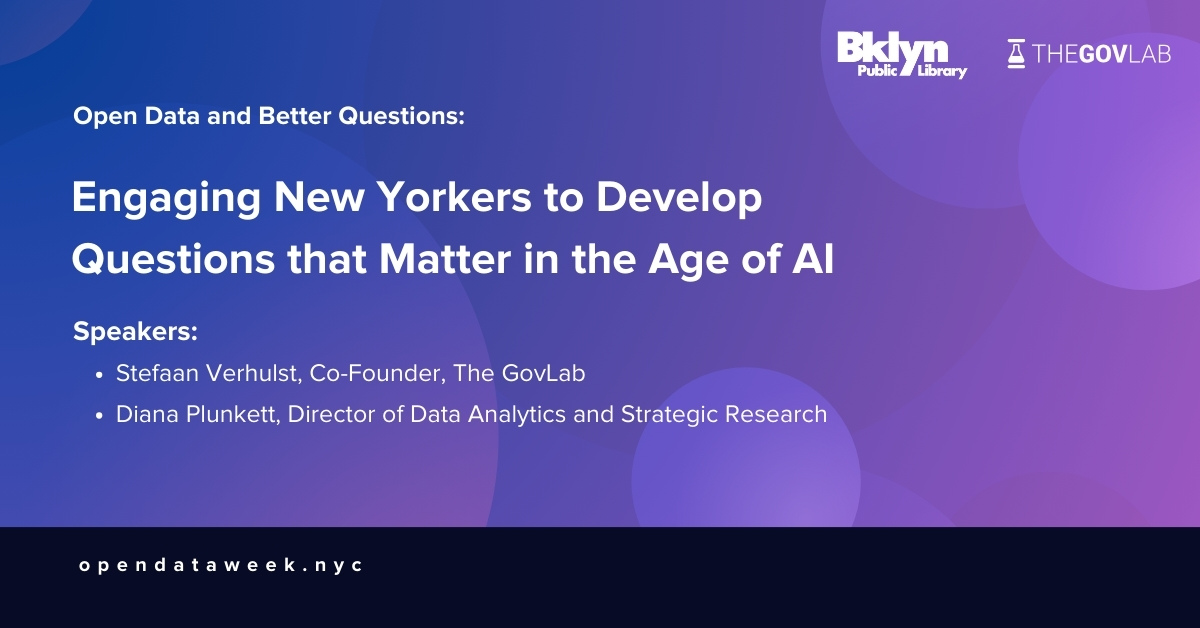
On Friday, March 27th from 2:00 PM to 3:30 PM at Brooklyn Central Library, The GovLab, the Brooklyn Public Library and Alliance for Public Interest Technology at New York University will be hosting a special “Questions Lab” as part of New York City Open Data Week 2026. In it, we will give New Yorkers the opportunity to formulate good, data-driven questions about the issues they care about and to meaningfully connect those questions to specific datasets in NYC Open Data or other, non-traditional repositories. It will include a brief presentation followed by small group discussion on the questions that New Yorkers care about:
2:00 – 2:20 PM: Setting the Scene: Stefaan Verhulst (Co-Founder, The GovLab), Diana Plunkett (Director of Data Analytics, Brooklyn Public Library), and Manny Patole (Senior Fellow, Alliance for Public Interest Technology) will explain the work that Brooklyn Library and The GovLab are doing to help residents not only understand data that describes them but to engage with it meaningfully to solve problems they care about.
2:20 – 2:50: Topic Mapping and Question Definition: Attendees will be broken into small groups and taught how to define data-driven questions. Each group will focus on a different domain prioritized by the New York Mayor’s Office.
2:50 – 3:30: Group Voting on Questions and Debrief: Each group will present their questions. Referencing NYC Open Data and other datasets, the collective group will identify what data might exist in New York to answer these questions. They will then vote on which questions they consider the highest priority based on demand, actionability, and the larger regulatory context.

The end result of this work will be a prioritized mapping of the questions that matter for New Yorkers. This event is open to any New York resident interested in data and how it can be used to set a policy agenda. Participants will leave the event with a practical methodology for developing well-crafted, data-driven questions and the work they produce will inform new open data research. Register here.

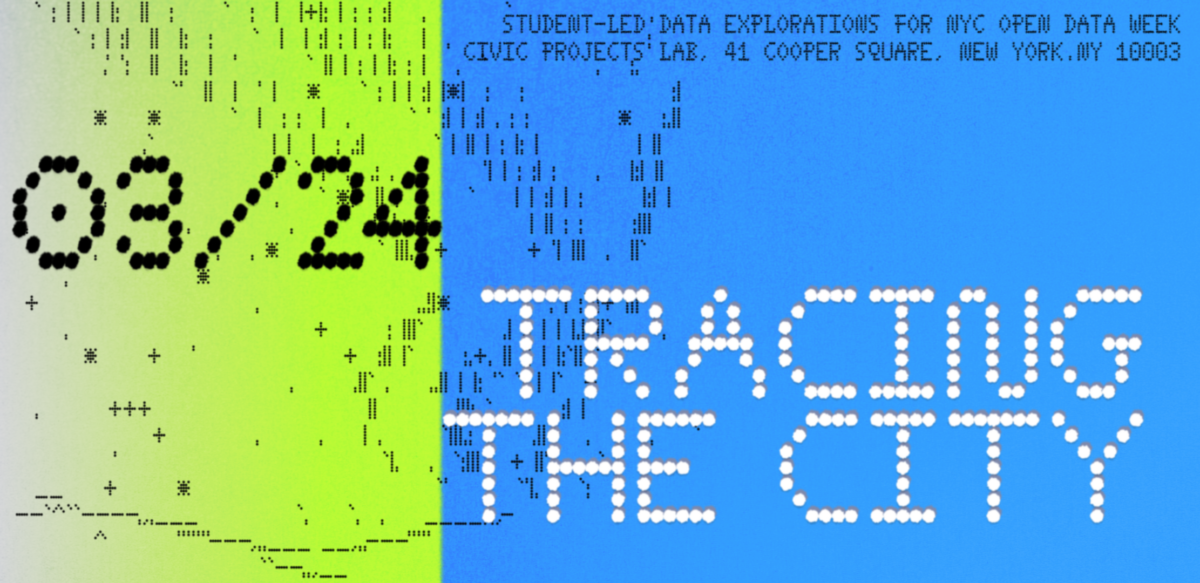
Tracing the City features student work from The Cooper Union’s interdisciplinary course, Data Science for Social Good, that pairs engineering, art, and architecture students with New York City nonprofits to help address real-world challenges together. Through the course, Cooper Union students help these organizations explore open datasets drawn from NYC Open Data sources, communicate findings visually, and propose data-informed interventions. Projects often highlight disparities in health outcomes, environmental conditions, educational access, and justice-system involvement across different city neighborhoods. This year, students are collaborating with NYC-based nonprofits—including organizations such as Bee U, Civic Health Alliance, and Justicia Lab, and Housing Rights Initiative—to investigate how open data can support youth empowerment, community health, tenancy protections, and corporate wage theft.

For Open Data Week 2026, we are hosting a public exhibition and reception showcasing work from this year’s Data Visualization and Data Science for Social Good cohort, alongside selected projects from previous years. The exhibition will feature a range of student work installed in The Cooper Union Civic Projects Lab; ranging from interactive installations, posters, visual narrative studies, and digital prototypes— all built using NYC Open Data and nonprofit partner datasets. The event is designed to be highly participatory: student teams will be present throughout the space to walk attendees through their datasets, demonstrate interactive components, discuss methodologies, and engage in open conversation about their findings and design choices. Rather than a static gallery, the exhibition will function as an open studio environment where visitors can test interactives, review visual drafts, ask questions directly to student creators, and learn how open data is used to support real-world challenges faced by NYC communities. A brief opening talk will introduce the pedagogy of the course and the role of open data in civic problem-solving, but the emphasis will be on hands-on engagement and informal dialogue. The goal is to create an accessible and welcoming public space where open data comes alive through student-led exploration, community insight, and interactive design. Register here.

Public scholarship has been a core value and practice of the CUNY Graduate Center since its founding 1961, and long part of the culture of CUNY, the largest urban public university in the United States. Increasingly, public scholars committed to creating and disseminating knowledge in service of the public good work with open data in their projects, and disseminate their work in open scholarly publishing platforms, curate and release public datasets, and engage in digital media to share their work for public audiences.

This interactive panel discussion will provide an overview of how public scholarship, scholar activism, and open data have many existing links in projects supported by The Public Scholarship Practice Space (PS2) at The Center for the Humanities at The CUNY Graduate Center. It will then showcase and reflect on several recent projects completed by graduate students at CUNY whose work focused on public scholarship, activism, arts-based methods, digital equity, and civic tech. Three of the identified presenters were 2025 Early Research Initiative/Public Scholarship Practice Space 2025 Summer Research Fellows and two presenters were Social Practice CUNY Fellows.

– Ian G. Williams will share his research on digital literacy, civic tech networks, and democracy through participation in The Impacts of Civic Technology Conference (TICTeC) in Mechelen, Belgium in July 2025, experiments in creating pedagogical tools bridging open data literacy and data justice in a social work classroom while examining 311 complaints about homelessness, and involvement with the NYC Public Interest Tech (PIT) Pop-Up this fall. Read Ian’s write-up on summer activities here.

– Seon Britton will share his research on community technology organizations (CTOs) working to advance digital equity and inclusion in New York City through broadband internet service provision, including fieldwork with Silicon Harlem and NYC Mesh. His work argues that CTOs are a new type of organization that can help in providing internet access to currently underserved communities. Read Seon’s write-up on summer activities here.

– Jaclyn Reyes and Ezra Undag will share their work with The UKAI Initiative, a transnational collaboration of artists, cultural workers and researchers in the US and in the Philippines that aims to advance environmental and climate justice through art, culture and community-building. The UKAI Initiative has several projects; this presentation will focus on the project, “Transnational Clothing Pathways.” Read more about The UKAI Initiative here.

NYC School of Data is BetaNYC’s community conference that demystifies the policies and practices around open data, technology, and service design. This year’s conference helps conclude NYC Open Data Week and features 40+ sessions organized by NYC’s civic technology, data, and design community! Our conversations and workshops will feed your mind and inspire you to improve your neighborhood.

To attend, you need to purchase tickets. The venue is accessible, and the content is all-ages friendly! If you have accessibility questions or needs, please email the BetaNYC team at [email protected].

Thank you to Reinvent Albany for their support as Lead Partner and helping cover conference costs to make it possible to meet in 2026. Additional sponsors include HaydenAI, SVA Masters in Data Visualization and Communication, Nava, The Center for Urban Science + Progress (CUSP) at NYU Tandon. and Cyvl

If you can’t join us in person, tune into the main stage live stream provided by the Internet Society New York Chapter. Follow the conversation #NYCSoData on Bluesky.

Purchase your tickets here.