
Street tree planting delivers well-documented environmental and public health benefits, but it also interacts with housing markets in complex ways. This virtual session uses open data to explore how urban greening strategies may shape housing prices and rents in New York City.

Drawing on NYC Open Data and other publicly available housing, demographic, and environmental datasets, the presentation will walk through the data sources, modeling approach, and key findings of this analysis. The session also features a live demonstration of a web-based interactive simulation tool that allows participants to explore different tree-planting scenarios and their potential market impacts, supporting more informed, transparent, and equitable decision-making around urban greening investments. This session is designed for planners, policymakers, researchers, advocates, and community members. No technical background is required.

The project is led by Dr. Hanxue Wei, Industry Assistant Professor at NYU’s Center for Urban Science + Progress (CUSP). Archy Guo, Graduate Research Assistant at CUSP, is leading the presentation and conducting the core analytical work. The project team also includes Dr. Max Vilgalys, Climate Policy Analyst at NYC Office of Management and Budget, and Dr. Alex Azan, Assistant Professor at NYU Langone Health.
Local Law 97 of 2019 is one of the nation’s most ambitious climate laws, setting carbon emissions limits for most large buildings across New York City. As the first major compliance deadlines take effect, data has become a central driver—shaping how agencies, nonprofits, and building owners understand performance, identify risks, and plan for long-term decarbonization.

This session brings together experts from city agencies and the private sector partners to explore how open data and public datasets are transforming the city’s approach to building emissions. Speakers from NYC Housing Preservation & Development (HPD), the Department of Buildings (DOB), the Mayor’s Office of Climate & Environmental Justice (MOCEJ), and Cadence OneFive will share how their organizations use data to implement the law, monitor energy usage, model carbon impacts, develop compliance services, and design equitable climate strategies.

Professionals, civic technologists, and the general public who are interested in the role of data in climate resiliency, building decarbonization, affordable housing, and climate policy will most benefit from attending this session.

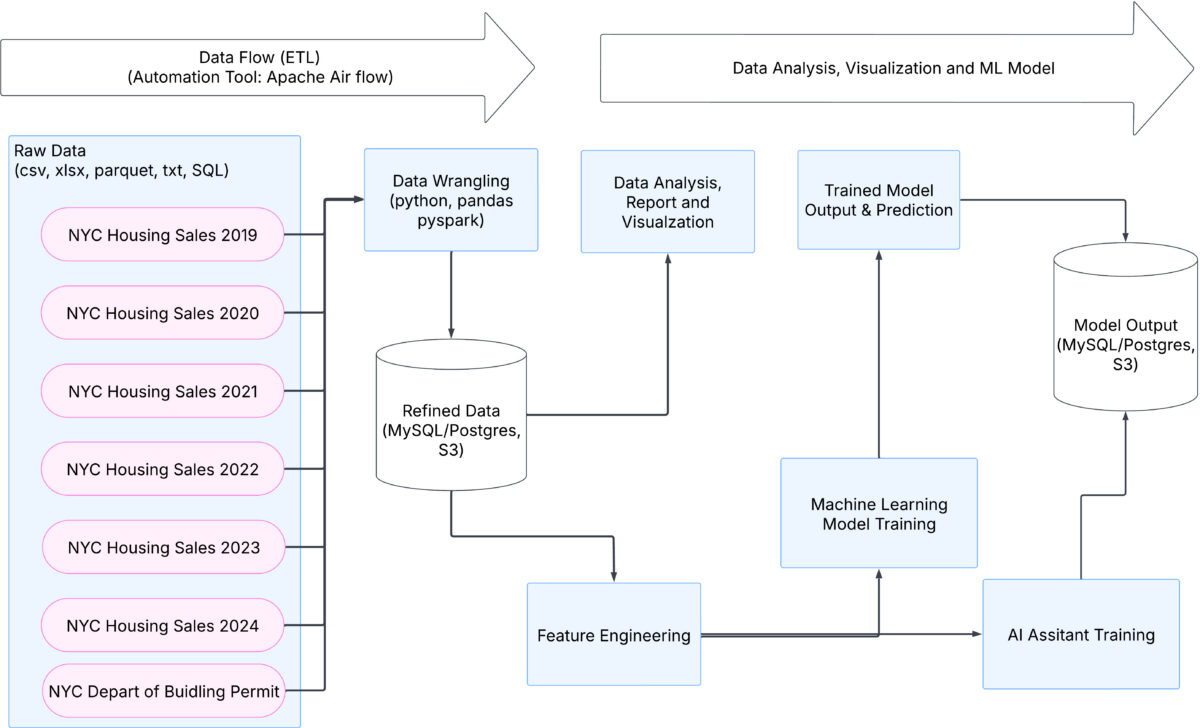
This session explores advanced analysis of NYC residential property sales (2019–2024) using NYC Open Data, with a focus on model improvement and AI integration. Researchers Yue Ru Li and Chunhong Zhao will demonstrate how combining Department of Finance sales data with Department of Buildings permit data can enhance predictive performance. Participants will work through a hands-on Python notebook covering feature engineering, data visualization, and machine learning models, while also learning how an embedded AI assistant can streamline data cleaning, feature generation, and model interpretation.

Join Census Bureau data dissemination specialists Joli Golden and David Kraiker to learn how to use data.census.gov to access the most current and relevant demographic, socioeconomic, and housing statistics about your community. During this presentation, you will learn about the Decennial Census, the American Community Survey (ACS) and other Census Bureau programs, geographies, and datasets. Plus, you will see live demonstrations of the search and navigation features in data.census.gov as well as how to download tables, create charts and generate thematic maps. This training is recommended for all data users.