

- This event has passed.
What 13 Million 311 Complaints Reveal About New York City’s Quality of Life
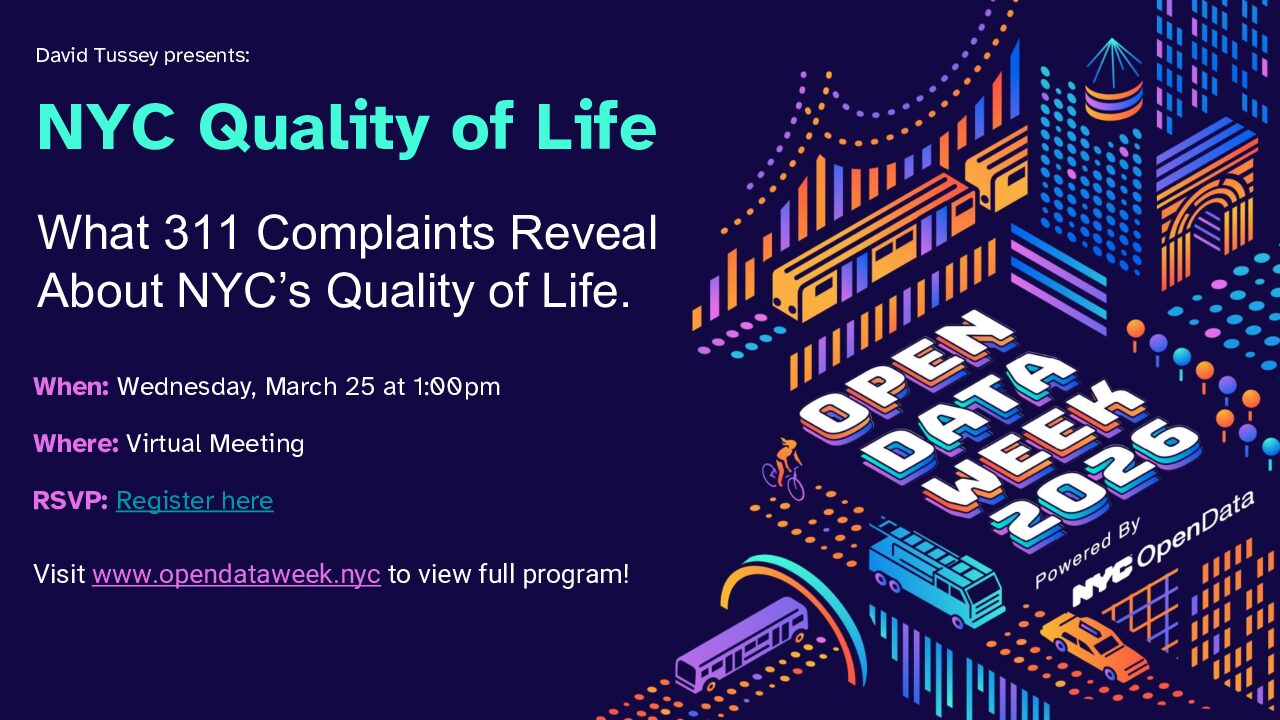
In this session, David Tussey — retired technology executive and former executive director in the NYC Department of Information Technology and Telecommunications (DoITT, now OTI) — presents a data-driven Quality of Life Index built entirely from NYC’s 311 Service Request open dataset. Drawing on more than 13 million complaint records spanning 2020 through 2025, the analysis tracks 30 complaint categories across five quality-of-life domains — from shelter conditions and neighborhood cleanliness to street safety and social distress — and measures how each has changed relative to a pre-established baseline. The methodology, developed with guidance from mentor Dr. Jun Yan of the University of Connecticut Department of Statistics, applies seasonally adjusted indexing and Statistical Process Control techniques to surface meaningful trends in public service demand.
Participants will see a live walkthrough of the analytical pipeline built in R using NYC Open Data, including data preparation, index computation, and publication-ready visualizations. The session is part demonstration, part methodology discussion, and part provocation — the findings raise real questions about urban quality of life that city agencies, policymakers, and engaged New Yorkers will want to wrestle with.
This session is ideal for city employees working in technology or data roles, academics and students interested in applied urban analytics, and anyone curious about what 311 data can reveal when you look beyond individual complaints. No prior technical background is required to follow the findings, though data practitioners will find the methodology discussion valuable. Attendees are encouraged to come with questions.